

The unclassifiable

Updated: Jul 30
A step sideways
On this blog, I have mostly written about mechanical watches. So allow me a small detour: one of the watches I most enjoy wearing at the moment has no balance wheel, no rotor. It has a screen. A digital display, figures that light up, a battery inside.

It is a Tissot PRX Digital, and on paper it has no business sitting in the collection of someone who loves mechanical watches. Too simple, too electronic, too far from everything that usually makes an enthusiast's heart beat faster. I have asked myself the question before, some time ago, about my G-Shock: does a digital watch belong in a watch lover's collection? My answer then was yes, without hesitation. The PRX Digital, in its own way, carries that answer further.
This watch has a rare quality. It fits into no category. Not quite dressy, not quite sporty. Not really expensive, not really cheap. Neither a man's watch nor a woman's. Neither a serious object nor a mere gadget. It is precisely this refusal of labels that appeals to me.
A watch without pressure
I did not really go looking for this watch. It turned up, almost by chance, and I took it for what it was: a passing urge to try something different. Not the fulfilment of a long-held desire, not the marker of a milestone, simply the plain pleasure of a watch you pick up without ceremony.

Perhaps that is why it relaxes me so much. My other watches carry a certain weight, that of their price, their history, what they stand for. This one carries none. I can knock it, get it wet, forget it in a drawer and find it again weeks later with the same pleasure intact. It asks for nothing, demands no particular care. It is precisely this lightness, in both senses of the word, that makes it so easy to wear.
The retro-futurist Frankenstein
To understand this watch, you have to accept a slightly strange idea: the PRX Digital is a sort of horological Frankenstein's monster. A creature stitched together from parts that should not belong together, and which nonetheless stands tall, and proudly so.
The first part is the body. A tonneau case, a slim bezel, an integrated bracelet flowing out of the case band: the whole vocabulary of 1970s sports-chic, the one we owe to Gérald Genta and his now legendary designs. The PRX invents nothing here, it embraces its heritage. The first PRX dates from 1978, when this integrated style was all the rage in the wake of the Royal Oak, the Nautilus and the Laureato. It belongs fully to that family.
The second part is the heart, and this is where the graft becomes surprising. Onto this refined body, Tissot has fitted a digital display. A liquid crystal screen, figures that light up. The original PRX, in 1978, was admittedly a quartz watch, but one with hands. This digital version never existed as such at the time. The phrase false memory would suit it well, that of a reinvented past: a watch that evokes the digital aesthetic of the 1970s and 1980s without truly being its direct descendant. The monster, here, even assembles fragments of pasts that never coexisted.

Digital, I will say again, has never put me off. I grew up with these battery-and-screen watches, and I keep a genuine fondness for them. Casio, G-Shock, all those watches that own their electronics without apology have their own culture and their own charm. The PRX Digital draws on that same imagination, but dresses it differently.
The pleasure of using it is almost childlike. The screen shows the time, the date, a second time zone, a chronograph and a timer. With every press of a button, a small beep sounds, adding to the object's geeky side. The backlight comes on by holding the button at eleven o'clock, then stays lit for as long as you keep working the other buttons to move through the functions. Not every digital watch does this, and it is very handy: you can explore the functions in the dark without having to switch the light back on again and again. Nothing extraordinary, just a small touch that proves very practical.
The easy way out, really?
I can guess the objection. One might see this PRX Digital as the easy way out. Take a watch that already exists, the PRX with hands, and graft a digital module onto it: is that not making something new out of something old? A slightly opportunistic assembly: you take a base that works, you add a screen, and the job is done.

The argument holds. Yet that is not how I see things. Where some would see a patch-up job, I see an original watch, endearing precisely because of its ambivalence. This improbable assembly produces something that neither the PRX with hands nor a standard digital watch possesses. The refinement of the integrated bracelet, that slightly dressy, slightly precious quality, sits alongside the geeky, playful side of the digital. Two worlds that everything sets apart, brought together on a single wrist. That very contrast is what gives it all its charm.
The feel and the details
If I had to single out what I prefer about this watch, it would be its bracelet without hesitation. Integrated into the case, it is of the single-link type, remarkably fluid. It hugs the wrist, ripples without stiffness, and you sense in the wearing a real quality of manufacture. One detail makes it particularly successful: its width tapers subtly between the link at the case band and the last link near the clasp, which slims the line and refines the silhouette. The clasp is a butterfly clasp with push-buttons, opening from the centre, discreet and secure.

The finishing deserves a closer look. The bracelet is entirely brushed, which gives the watch a pleasing sobriety, with no flashiness. Despite this plain finish, the play of light remains interesting: the links are flat, and their surfaces catch the light in clean bands that come alive depending on the angle of the wrist.

The case too is brushed, but lifted by a polished chamfer that underlines its edges. The bezel, polished, adds a final touch of shine. The dial is a deep black beneath the sapphire crystal, and that depth adds relief to the whole, breaking somewhat with the watch's overall monochrome look.

The rest follows the same level of care, unexpected at this price. A sapphire crystal, all but scratchproof, where so many digital watches make do with plastic or mineral glass. This PRX offers water resistance to 100 metres and an easy strap-change system, even if, the bracelet being integrated, the options for swapping it remain very limited. Here, I was not able to enjoy changing strap like I did with the OW P-104 Selectron, ma Oris Big Crown Pointer Date and my Glycine Airman MLV.

The relative slimness of the case and its overall lightness, finally, make it disappear on the wrist. The PRX Digital is no throwaway watch: it hides real substance beneath its light-hearted looks.
Neither man's nor woman's
That leaves the question of size, and with it, of gender. At 35 millimetres, the PRX Digital is a small watch, and some retailers do file it under the women's section. That is a dated reflex. Tissot does not draw the line. The brand offers this diameter in its men's collection as much as in its women's. The intention, then, is rather that of a genderless watch, and I wholeheartedly approve. The charge of being a "woman's watch" does not come from the brand, but from a habit of the market that struggles to shake off its old categories.
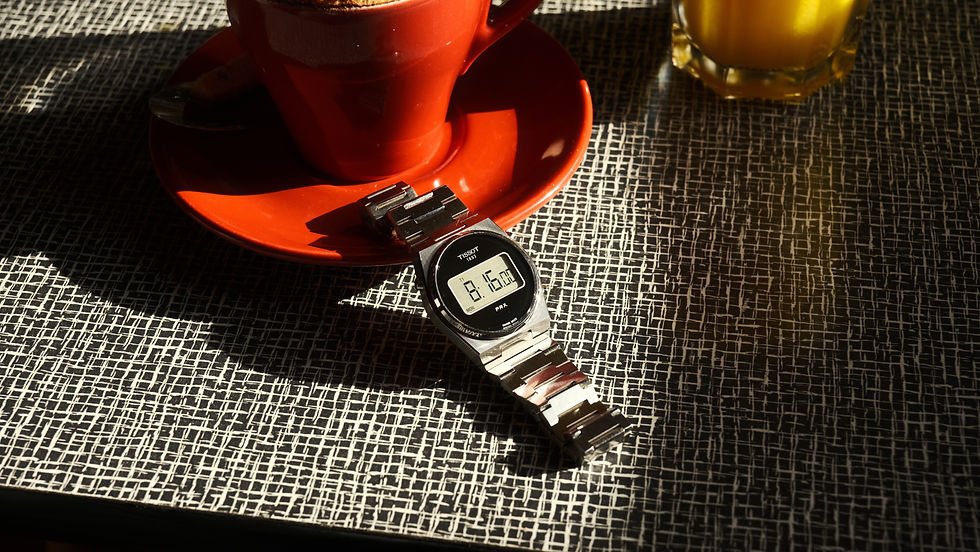
One detail nonetheless hints at an older intention. I did not have to remove a single link from the bracelet, even though my wrist is not especially large. It makes you wonder whether this sizing was not first meant for women's wrists. No matter, in the end: it suits me, and I wear it with pleasure. I even like to wear it a little loose, floating slightly on the wrist, almost like a bracelet, with that faintly offbeat quality that delights me. A large watch demands a certain bearing; a small one allows for whimsy.
The fate of an unclassifiable watch
There is one last thing to say, and it only half surprises me: the PRX Digital no longer appears in Tissot's catalogue. I cannot be sure, but I suspect it did not fully win the public over, and perhaps its price had something to do with it. A watch this hybrid, this unclassifiable, was no doubt too singular to win over the many.
There is something in that which, oddly, makes it all the more endearing to me. Its commercial fate seems to mirror its nature: too strange for the market's categories, it quietly slipped out of them, to join the more confidential territory of watches we love precisely because they never found their place. I love a watch that the market could not hold on to.
That is perhaps what it has allowed me to confirm once again. A watch's pleasure rests neither on its price, nor on its movement, nor on the labels we stick on it, size, gender, category. It rests on what it makes us feel when we wear it. The PRX Digital fits into no category, and that is exactly why I love it. The watches that move me most are often the ones that refuse to be filed away.


Comments